
A number designed to make you feel small
The headline returns every few months, reliable as a bad dream: seven American tech companies are worth more than the combined GDP of the European tech industry, Europe, and the United Kingdom together. It is designed to shock. It is designed to suggest that the game is over; that Silicon Valley won; that Europeans should accept their place as consumers of American platforms and audiences for American narratives. It is also, from any serious analytical standpoint, a lie.
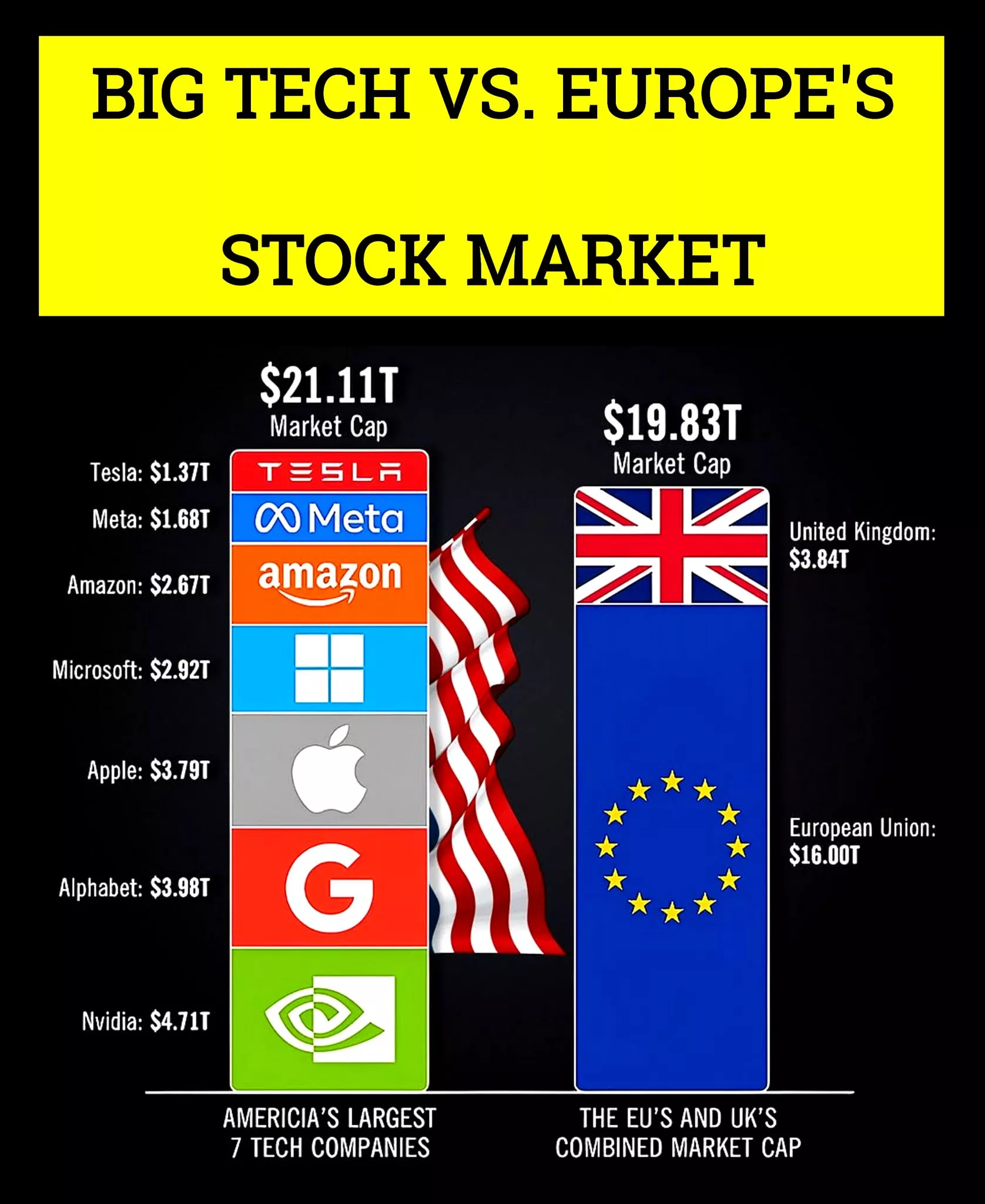
The usual fake news : Europe GDP compared to US Biggest tech companies.
Market capitalisation and GDP do not measure the same thing. They are not even close to comparable. GDP measures what an economy actually produces each year; real goods, real services, renewed every twelve months. Market capitalisation measures what financial markets are willing to bet, today, on a company’s imagined future earnings. One is a flow of productive reality. The other is a stock of speculative fiction.
If you want a comparison that means something, compare revenues. Apple, Microsoft, Alphabet, Amazon, Meta, Nvidia, and Tesla combined generated roughly $1.8 trillion in revenue. The European Union’s GDP exceeded $18 trillion the same year. Europe is ten times larger. The graphic that was supposed to humiliate us proves the opposite, the moment you use the right numbers.
The S&P 500 is not a monument to American genius; read it upside down, and you are looking at the slow collapse of the dollar’s purchasing power.
How a printing press became a valuation machine
To understand how Nvidia reached a market capitalisation above $3 trillion, or how OpenAI claimed a valuation near $1 trillion while selling almost nothing at scale, you need to understand what the Federal Reserve did to the dollar over fifteen years.
After 2008, the Fed expanded its balance sheet from under $1 trillion to nearly $9 trillion. That money did not build roads or train workers. It flowed, structurally and deliberately, into financial assets. The largest US corporations borrowed at rates near zero; many issued debt at negative real rates for over a decade. They did not invest that capital in factories. They bought back their own shares, concentrated ownership, and watched their valuations inflate in a currency that was simultaneously losing value.
The mechanism is simple. When the unit of account loses purchasing power, the nominal price of assets rises. A company valued at $200 billion in 2010 dollars can carry a $900 billion valuation in 2023 dollars while its actual productive output has grown modestly. The S&P 500 chart, read in the conventional direction, looks like a monument to American dynamism. Read correctly; it is a graph of monetary debasement dressed as economic victory.
This is the context in which “Tesla is worth more than every other carmaker combined” briefly made arithmetic sense. Tesla produced fewer than one million vehicles per year. Volkswagen produced over nine million. The valuation reflected cheap dollar liquidity stacked on top of speculative expectation; it reflected almost nothing about who was actually building things. That is the economy Europeans are being told to envy.
Europe produces; it does not perform for markets
Europe’s disadvantage in the valuation game is, in part, the direct consequence of its advantage in the real economy. European capitalism is built around patient capital, productive reinvestment, and long-term industrial capacity. It is not built around quarterly earnings theatre and share buyback programmes. The Rhineland model rewards factories and skilled workers. Wall Street rewards the story you can tell about factories you have not yet built.
ASML, a Dutch company, holds a global monopoly on the machines without which no advanced semiconductor can be manufactured anywhere on Earth. Its market capitalisation is a fraction of Nvidia’s. Airbus produces more commercial aircraft than Boeing, carries a healthier order book, and trades at a valuation that reflects none of the speculative fever attached to its American competitor. The European tech industry is not absent from the global economy; it is absent from the valuation circus. Those are different things, and Europeans should say so loudly.
The counterargument: Europe is genuinely behind in digital
There is a legitimate version of the critique, and it deserves a direct answer. In consumer digital platforms and foundational AI infrastructure, Europe has produced no global-scale challenger. There is no European Google, no European AWS, no European equivalent of the iPhone ecosystem. The Draghi competitiveness report 2024 documented this gap with uncomfortable precision; regulatory fragmentation, shallow capital markets, and chronic underinvestment in deep tech are the structural causes.
This is a real problem. It requires real solutions; deeper European capital markets, genuine progress on the Capital Markets Union, and industrial policy that rewards productive investment over financial performance. It does not require Europeans to accept a fraudulent metric as the verdict on their civilisation.
Acknowledging a gap in consumer platforms is specific and actionable. Conceding that “US tech outweighs Europe” is surrendering to a story built on printed money and financial engineering. One is a diagnosis. The other is propaganda.
What happens when the illusion breaks
The correction will come. It always does. The Federal Reserve’s rate cycle that began in 2022 already erased $7 trillion in US tech market capitalisation within twelve months. Valuations recovered as markets priced in AI-driven earnings expectations that remain, today, largely unverified by actual revenue. OpenAI is worth nearly a trillion dollars. It has yet to produce a profitable quarter.
When the correction arrives in force, its first impact will be in US financial markets. Its second impact will be felt in European export industries, in European pension funds carrying US equity exposure, and in the credit conditions available to European firms trying to build the industrial base Europe needs. European deindustrialisation is already a structural emergency; a violent US correction will arrive at the worst possible moment and accelerate the pressure on everything Europe is trying to rebuild.
Europe did not design this trap. It imported it through financial integration with a system built on dollar leverage and sustained by American monetary dominance. The answer is not retreat; it is the urgent construction of European digital sovereignty, continental capital markets that actually function, and an industrial strategy that does not depend on Wall Street’s mood.
What Europe must do; and stop doing
The first thing Europe must stop doing is repeating American financial narratives as though they were economic facts. Every time a European politician, journalist, or analyst cites the GDP-versus-market-cap comparison without challenging its premise, they are doing Washington’s communications work for free. It has to stop.
The second requirement is structural. European capital markets are fragmented by national borders; financing a continental-scale tech company from European sources remains genuinely harder than it should be. The Capital Markets Union has been a declared priority for a decade; it remains incomplete. That gap is costing Europe companies it should be building.
The third requirement is strategic. Europe must identify where it holds or can build defensible competitive positions; advanced manufacturing equipment, industrial software, quantum computing, sovereign cloud infrastructure, and the clean energy technologies that will define the next industrial cycle. Competing with Meta for social media engagement is a distraction Europe cannot afford. Competing with no one for EUV lithography machines is the position ASML already holds; and no one talks about it, because it does not fit the story of European decline.
The European tech industry does not need to win a valuation contest denominated in a currency the United States prints at will, judged by analysts whose bonuses depend on the S&P 500 going up. It needs to produce things the world cannot source elsewhere. In more domains than the headline writers acknowledge; it already does. We should say that. Loudly, and without apology.
| EU GDP (2023) | ~$18.4 trillion |
| Combined revenue, 7 largest US tech firms (2023) | ~$1.8 trillion |
| Combined market cap, 7 largest US tech firms (peak 2024) | ~$14–15 trillion |
| Federal Reserve balance sheet peak | ~$8.9 trillion (2022) |
| US tech market cap erased in 2022 correction | ~$7 trillion |
Stay informed. Stay sovereign.
Europa Maxima’s newsletter delivers geopolitical analysis directly to your inbox ; no algorithm, no filter.
Subscribe to Europa’s First Column →